

Shoulderdoc - Patient information and professional educational material on shoulder and elbow problems
For Treatment or More Information:
info@shoulderdoc.co.uk
0161 227 0027
Back Home Up Search

Shoulder

Shoulderdoc
Patient Information
Shoulder
AC joint problems sectionAC joint problems
Biceps Problems sectionBiceps Problems
Calcific Tendinitis sectionCalcific Tendinitis
Frozen Shoulder sectionFrozen Shoulder
Injections sectionInjections
Labral Tears sectionLabral Tears
Nerve Disorders of the Shoulder sectionNerve Disorders of the Shoulder
Pectoralis Major Ruptures sectionPectoralis Major Ruptures
Rotator Cuff Tears sectionRotator Cuff Tears
Shoulder Anatomy sectionShoulder Anatomy
Shoulder Arthritis sectionShoulder Arthritis
Shoulder Arthroscopy sectionShoulder Arthroscopy
Shoulder Dislocations sectionShoulder Dislocations
Shoulder Fractures sectionShoulder Fractures
Shoulder Scans sectionShoulder Scans
Shoulder Sling sectionShoulder Sling
SLAP Lesions sectionSLAP Lesions
Sports Injuries sectionSports Injuries
Subacromial Impingement sectionSubacromial Impingement
Winging Scapula sectionWinging Scapula
ShoulderShoulder
Condensing Osteitis ClavicleCondensing Osteitis Clavicle
Internal ImpingementInternal Impingement
Os AcromialeOs Acromiale
Shoulder Pain MapsShoulder Pain Maps
Shoulder Surgery in ParaplegicsShoulder Surgery in Paraplegics
Snapping ScapulaSnapping Scapula
Interactive SurgeryInteractive Surgery
Shoulder Surgery BookletShoulder Surgery Booklet


Google Shoulderdoc
[ Advanced Search ]

This website is certified by Health On the Net Foundation. Click to verify. This site complies with the HONcode standard for trustworthy health information: verify here.

ShoulderDoc.co.uk satisfies the INTUTE criteria for quality and has been awarded 'editor's choice'.


   >>Website last updated: 05 September 2010


Sitemap Sitemap   Print page Print   advanced searchSearch   email articleEmail

Os Acromiale

Authors - Dipankar Bhattacharyya & Lennard Funk

The acromion is the most prominent bone on the top of your shoulder. You can feel it easily. The acromion developes as four separate parts during childhood. These have all joined together (fuse) by the age of 25 years in most people. However, in 8% of people one or more of the parts do not fuse.
The ‘parts’, known as ossification centres are: Preacromion (pa) Mesoacromion (msa) Metacromion (mta)and Basiacromion (ba).
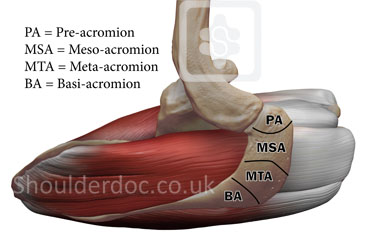
Failure of fusion between  msa and mta is most common but other combinations may be present so that there may  be 7 possible types of Os acromion.

The free fragment is usually one-third of the length of the acromion and includes the acromioclavicular facet and attachments of the coraco-acromial ligaments.(JBJS-B-1993 75-4)

A strong association with rotator cuff tears has been reported  but  is usually a co-condition rather than a causative factor (Act Orth.2000  76-2).

Pain is due to:

  1. Impingement from the unfused fragment bending forward with contraction of the deltoid and ‘traping’ the rotator cuff..
  2. Concomitant rotator cuff tear.
  3. Motion at the unfused site leading to arthritic changes.


This can present exactly like subacromial impingement, with superadded point tenderness.

X-rays are necessary to diagnose the os-acromiale. The best view is the axillary view of the shoulder, although it can be seen on other x-ray views. It can also be seen on MR, ultrasound and CT scans.

Treatment :

Initially:   Physiotherapy, anti-inflammatories and pain-killers

Injections: Depending on the site of pain - subacromial and directly into the unfused, arthritic site. Injections under ultrasound guidance are more accurate, if available.

Surgery
1. Fixation and Fusion of the unfused segments - Indicated for larger fragments, such as msa, mta and ba.  (J Shoulder Elbow Surg 2004 13-4). This is usually done by an open procedure, but can be done arthroscopically.
2. arthroscopic excision of the unfused fragment (Subacromial decompression) - Indicated for small pre-acromion (pa) only.
a. For more details on the surgery and rehabilitation click here

'key-hole' surgery. Surgery performed via small incisions, using special instruments and a viewing scope..
A tough band of connective tissue that connects two bones to each other. "Ligament" is a fitting term; it comes from the Latin "ligare" meaning "to bind or tie."


Print page Print page    email article Email article

Bookmark this page:

  • del.icio.us
  • digg.com
  • furl.net
  • google
  • ma.gnolia.com
  • netvouz.com
  • newsvine.com
  • netscape
  • reddit.com
  • simpy.com
  • spurl.net
  • stumbleupon
  • technorati.com
  • yahoo


Tags: No tags defined for this article. [View tag cloud]

If you are interested in making an appointment to discuss a treatment,
please click here to contact us, or telephone 0161 227 0027.

Related Articles

Shoulder
Information on Shoulder disorders and injuries. Click on the Menu on the left for i...
01/10/2009 06:45:14
Read more...

Internal Impingement
What is impingement? The word impingement basically means 'rubbing' or 'catching' of st...
27/12/2008 12:18:15
Read more...

Interactive Surgery
...
18/11/2008 20:08:19
Read more...

Shoulder Surgery Booklet
...
13/02/2008 10:46:45
Read more...

Shoulder Surgery in Paraplegics
Lennard Funk, 2005 The shoulder is the most common site of pain reported by the whe...
19/10/2007 13:09:10
Read more...

Snapping Scapula
Snapping scapula is the descriptive diagnosis for a range of factors that cause painful c...
19/10/2007 12:15:11
Read more...

Creative Commons Licence The material on this website is designed to support, not replace, the relationship that exists between ourselves and our patients. Full Disclaimer
Orthoteers online orthopaedic database Shoulder fellowships Manchester Shoulder Clinic Wrightington Upper Limb Unit
  Shoulderdoc.co.uk Website by Regency Medical Marketing