

Shoulderdoc - Patient information and professional educational material on shoulder and elbow problems
For Treatment or More Information:
info@shoulderdoc.co.uk
0161 227 0027
Back Home Up Search

Nerve Disorders of the Shoulder

Shoulderdoc
Patient Information
Shoulder
Nerve Disorders of the Shoulder
Nerve Disorders of the ShoulderNerve Disorders of the Shoulder
Fascioscapulohumeral DystrophyFascioscapulohumeral Dystrophy
Parsonage-Turner SyndromeParsonage-Turner Syndrome
Trapezius Muscle PalsyTrapezius Muscle Palsy
Quadrilateral Space SyndromeQuadrilateral Space Syndrome
Suprascapular Nerve PalsySuprascapular Nerve Palsy


Google Shoulderdoc
[ Advanced Search ]

This website is certified by Health On the Net Foundation. Click to verify. This site complies with the HONcode standard for trustworthy health information: verify here.

ShoulderDoc.co.uk satisfies the INTUTE criteria for quality and has been awarded 'editor's choice'.


   >>Website last updated: 05 September 2010


Sitemap Sitemap   Print page Print   advanced searchSearch   email articleEmail

Quadrilateral Space Syndrome

L Funk, J Harris

The quadrilateral space is located posterior and inferior to the glenohumeral joint and contains the axillary nerve and posterior humeral circumflex artery. The space is bounded superiorly by the teres minor muscle, inferiorly by the teres major muscle, medially by the long head of the triceps, and laterally by the humeral shaft.

Quadrilateral space syndrome (QSS) is compression of the axillary nerve and posterior humeral circumflex artery as they pass through this space.
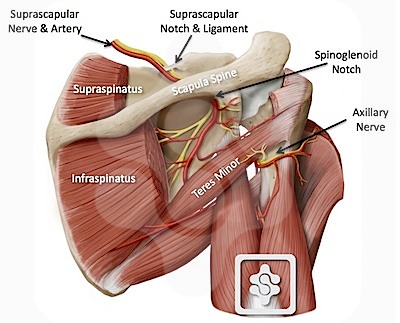
This is a vary rare condition, but should be suspected in athletes with the symptoms below.

Aetiology:
The typical causes of QSS are:
- Fibrous bands in the quadrilateral space, tightening in abduction and external rotation.
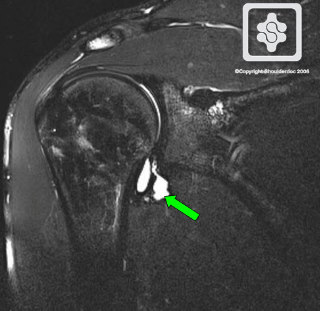
- Paralabral cysts, associated with inferior labral tears is the commonest cause we have found in contact athletes.
- Very rarely: tumours and haematomas

Clinical Presentation:
QSS typically occurs in in young athletic adults in the age range of 25 to 35 years without a history of significant trauma.
The pain is characterized clinically by a dull intermittent ache localized in the posterior and lateral shoulder. These symptoms are exacerbated by active and resisted abduction and external rotation of the humerus. Point tenderness is often present overlying the quadrilateral space posteriorly at the insertion site of the teres minor. Atrophy or weakness of the teres minor and deltoid muscle may also be noted.Paresthesias mayy occur in the cutaneous sensory distribution of the axillary nerve, overlying the deltoid muscle in the lateral shoulder and upper posterior arm.

The diagnosis of QSS can be difficult and many patients with this condition are often diagnosed and treated for other conditions before the diagnosis is finally made. This can complicate the clinical picture. Often patients will have been misdiagnosed as impingement and had subacromial decompressions or other interventions.

Investigations:
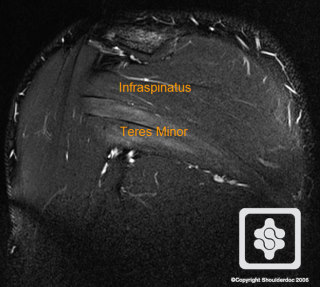
MRI Scan - this will demonstrate the atrophy of teres minor (and rarely deltoid) and show any large paralabral cysts, tumours or haematomas.
MR Arthrogram - will demonstrate all the above, plus any associated labral lesions (Our preferred scan)

MR Arthrogram showing a typical inferior paralabral cyst associated with a labral tear, causing QSS
MRI Scan showing atrophy of Teres Minor
Treatment:
For minor symptoms, little weakness and no significant mass lesion on MR scanning rehabilitation and functional strengthening can result in improvements over a few months.
For significant weakness and functional disability surgical decompression is indicated. Parlabral cysts can be approached arthroscopically and the associated labral tear repaired. Other large mass lesions require open surgical excision.

Outcomes:
Successful appropriate treatment should result in full recovery. Case Studies in the literature report full recovery within 3-6 months.


REFERENCES

  1. McAdams TR, Dillingham DF. Surgical Decompression of the Quadrilateral Space in Overhead Athletes. Am J Sports Med. 36:538-32. 2008.
  2. Cahill BR, Palmer RE. Quadrilateral space syndrome. J Hand Surg
    Am. 1983;8:65-69.
  3. Chautems RC, Glauser T, Waeber-Fey MC, Rostan O, Barraud GE. Quadrilateral space syndrome: case report and review of the literature. Ann Vasc Surg. 2000;14(6):673-676.
  4. Cormier PJ, Matalon TA, Wolin PM. Quadrilateral space syndrome: a rare cause of shoulder pain. Radiology. 1988;167:797-798.
  5. Cothran RL, Helms C. Quadrilateral space syndrome: incidence of imaging findings in a population referred for MRI of the shoulder. AJR Am J Roentgenol. 2005;184:989-992.
  6. Francel TJ, Dellon AL, Campbell JN. Quadrilateral space syndrome: diagnosis and operative decompression technique. Plast Reconstr Surg. 1991;87(5):911-916.
  7. Hoskins WT, Pollard HP, McDonald AJ. Quadrilateral space Syndrome: a case study and review of the literature. Br J Sports Med. 2005;39(9):e9.
  8. Ishima T, Usui M, Satoh E, Sakahashi H, Okamura K. Quadrilateral space syndrome caused by a ganglion. J Shoulder Elbow Surg. 1998;7(1):80-82.
  9. Lester B, Jeong GK, Weiland AJ, Wickiewicz TL. Quadrilateral space syndrome: diagnosis, pathology, and treatment. Am J Orthop. 1999;12:718-722.
  10. Okino S, Miyaji H, Matoba M. The quadrilateral space syndrome. Neuroradiology. 1995;37(4):311-312.
  11. Redler MR, Ruland LJ, McCue FC. Quadrilateral space syndrome in a throwing athlete. Am J Sports Med. 1986;14(8):511-513.
  12. Robinson P, White LM, Lax M, Salonen D, Bell RS. Quadrilateral space syndrome caused by a glenoid labral cyst. AJR Am J Roentgenol. 2000;175:1103-1105.
  13. Safran MR. Nerve injury about the shoulder in athletes, part I: suprascapular and axillary nerve. Am J Sports Med. 2004;32:803-819.
  14. Sanders TG, Tirman PF. Paralabral cyst: an unusual cause of quadrilateral space syndrome. arthroscopy. 1999;15(6):632-637
McAdams TR, Dillingham DF. Surgical Decompression of the Quadrilateral Space in Overhead Athletes. Am J Sports Med. 36:538-32. 2008.
  • Cahill BR, Palmer RE. Quadrilateral space syndrome. J Hand Surg
    Am. 1983;8:65-69.
  • Chautems RC, Glauser T, Waeber-Fey MC, Rostan O, Barraud GE. Quadrilateral space syndrome: case report and review of the literature. Ann Vasc Surg. 2000;14(6):673-676.
  • Cormier PJ, Matalon TA, Wolin PM. Quadrilateral space syndrome: a rare cause of shoulder pain. Radiology. 1988;167:797-798.
  • Cothran RL, Helms C. Quadrilateral space syndrome: incidence of imaging findings in a population referred for MRI of the shoulder. AJR Am J Roentgenol. 2005;184:989-992.
  • Francel TJ, Dellon AL, Campbell JN. Quadrilateral space syndrome: diagnosis and operative decompression technique. Plast Reconstr Surg. 1991;87(5):911-916.
  • Hoskins WT, Pollard HP, McDonald AJ. Quadrilateral space Syndrome: a case study and review of the literature. Br J Sports Med. 2005;39(9):e9.
  • Ishima T, Usui M, Satoh E, Sakahashi H, Okamura K. Quadrilateral space syndrome caused by a ganglion. J Shoulder Elbow Surg. 1998;7(1):80-82.
  • Lester B, Jeong GK, Weiland AJ, Wickiewicz TL. Quadrilateral space syndrome: diagnosis, pathology, and treatment. Am J Orthop. 1999;12:718-722.
  • Okino S, Miyaji H, Matoba M. The quadrilateral space syndrome. Neuroradiology. 1995;37(4):311-312.
  • Redler MR, Ruland LJ, McCue FC. Quadrilateral space syndrome in a throwing athlete. Am J Sports Med. 1986;14(8):511-513.
  • Robinson P, White LM, Lax M, Salonen D, Bell RS. Quadrilateral space syndrome caused by a glenoid labral cyst. AJR Am J Roentgenol. 2000;175:1103-1105.
  • Safran MR. Nerve injury about the shoulder in athletes, part I: suprascapular and axillary nerve. Am J Sports Med. 2004;32:803-819.
  • Sanders TG, Tirman PF. Paralabral cyst: an unusual cause of quadrilateral space syndrome. arthroscopy. 1999;15(6):632-637


  • 'key-hole' surgery. Surgery performed via small incisions, using special instruments and a viewing scope..
    at the botom; towards the feet
    The labrum is a firm, white structure that forms a ring around the glenoid cavity (the cup of the ball and socket shoulder joint). It deepens the socket, providing stability to the joint.
    at the side or outer aspect
    towards the centre of the body; inwards
    at the back; behind
    at the top; towards the head


    Print page Print page    email article Email article

    Bookmark this page:

    • del.icio.us
    • digg.com
    • furl.net
    • google
    • ma.gnolia.com
    • netvouz.com
    • newsvine.com
    • netscape
    • reddit.com
    • simpy.com
    • spurl.net
    • stumbleupon
    • technorati.com
    • yahoo


    Tags: [Neuromuscular] [ Sports] [View tag cloud]

    If you are interested in making an appointment to discuss a treatment,
    please click here to contact us, or telephone 0161 227 0027.

    Related Articles

    Football (Soccer) Shoulder Injuries
    As presented at the FA National Game Medical Conference on 4th July 2010 INTRODUCTION...
    13/08/2010 09:26:31
    Read more...

    Pectoralis major rupture in strength athletes: Footprint technique and results.
    Over a two year period, ten male strength athletes underwent repair of the pectoralis maj...
    07/03/2010 15:50:16
    Read more...

    Posterior dislocation of the sternoclavicular joint and epiphyseal disruption of the medial clavicle with posterior displacement in sports participants
    We retrospectively analysed the clinical results of 30 patients with injuries of the ster...
    24/01/2010 14:17:50
    Read more...

    Sports Injuries
    Sports Shoulder Injuries Shoulder Dislocations ACJ Injuries Impingement ...
    07/01/2010 07:24:37
    Read more...

    Pectoralis Major Muscle Rupture in Athletes: A Prospective Study
     Background In the past 20 years, there has been an increase in the incidence of u...
    06/01/2010 07:24:17
    Read more...

    Pectoralis Major Allograft Reconstruction
    History: I was into weight training and bodybuilding from the age of 13, blessed with a ...
    06/01/2010 07:23:30
    Read more...

    Creative Commons Licence The material on this website is designed to support, not replace, the relationship that exists between ourselves and our patients. Full Disclaimer
    Orthoteers online orthopaedic database Shoulder fellowships Manchester Shoulder Clinic Wrightington Upper Limb Unit
      Shoulderdoc.co.uk Website by Regency Medical Marketing