
Shoulderdoc - Patient information and professional educational material on shoulder and elbow problems
For Treatment or More Information:
info@shoulderdoc.co.uk
0161 227 0027
Back Home Up Search

Shoulder Anatomy

Shoulderdoc
Patient Information
Shoulder
Shoulder Anatomy
Shoulder Muscles sectionShoulder Muscles
Shoulder AnatomyShoulder Anatomy
Bones & Joints of the ShoulderBones & Joints of the Shoulder
Shoulder LigamentsShoulder Ligaments
Shoulder TendonsShoulder Tendons
Nerves of the ShoulderNerves of the Shoulder
Shoulder BursaeShoulder Bursae
Glenoid LabrumGlenoid Labrum


Google Shoulderdoc
[ Advanced Search ]

This website is certified by Health On the Net Foundation. Click to verify. This site complies with the HONcode standard for trustworthy health information: verify here.

ShoulderDoc.co.uk satisfies the INTUTE criteria for quality and has been awarded 'editor's choice'.


   >>Website last updated: 05 September 2010


Sitemap Sitemap   Print page Print   advanced searchSearch   email articleEmail

Glenoid Labrum

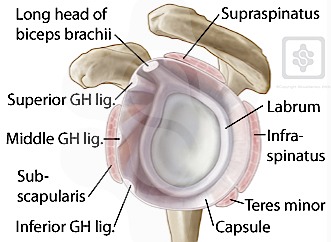
The shoulder joint is considered a 'ball and socket' joint, however, the 'socket' (the glenoid fossa of the scapula) is quite shallow and small, covering at most only a third of the 'ball' (the head of the humerus). The socket is deepened by the glenoid labrum.

The glenoid labrum is similar to the meniscus of the knee.  It is a fibro-cartilaginous rubbery structure which encircles the glenoid cavity deepening the socket providing static stability to the glenohumeral joint.  It acts and looks almost like a washer, sealing the two sides of the joint together.
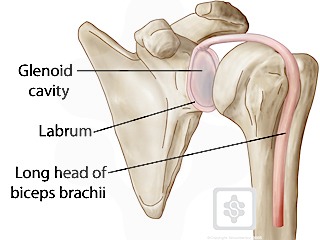


The labrum is described like a clock face with 12 o'clock being at the top (superior), 3 o'clock at the front (anterior), 6 o'clock at the bottom (inferior) and 9 o'clock at the back (posterior).  Clinicans may reverse the 3 o'clock and 9 o'clock for left shoulder describing 3 o'clock at the back. This can be confusing, so the European Society of Shoulder & Elbow Surgeons (SECEC) has agreed to keep 3 o'clock at the front for either shoulder.
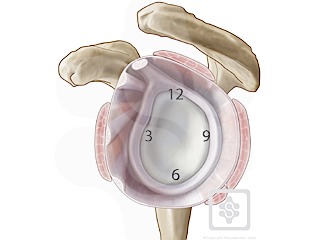

An injury to the shoulder with shear forces either in the anterior or posterior or superior directions leads to a labral tear in the affected area.  An injury between 3 and 6 o'clock is known as a Bankart tear . superior labral injury is known as a SLAP tear (superior labral anteroposterior).  A posterior tear of the posterior labrum is known as a posterior labral tear of reverse Bankart lesion.


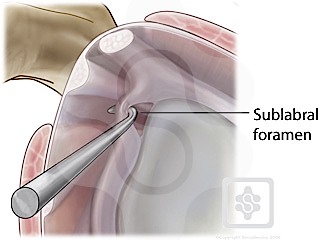
Sublabral foramen are anatomical variants, which is where the labrum can be 'lifted up' between 12 and 3 o'clock. It should not be confused with a labral tear, as its edge is clearly round and smooth and not red and ragged.


at the front; in front
A Bankart lesion is an injury to the anterior glenoid labrum associated with anterior shoulder dislocations. It usually requires surgical repair. It is named after Arthur Sydney Blundell Bankart, an English orthopaedic surgeon, who lived from 1879-1951.
at the botom; towards the feet
The labrum is a firm, white structure that forms a ring around the glenoid cavity (the cup of the ball and socket shoulder joint). It deepens the socket, providing stability to the joint.
A firm, white structure that forms a ring around the glenoid cavity (the cup of the ball and socket shoulder joint). It deepens the socket, providing stability to the joint.
at the back; behind
Superior Labral Antero-Posterior lesion - Abbreviated term for an injury to the superior labrum of the glenoid.
at the top; towards the head


Print page Print page    email article Email article

Bookmark this page:

  • del.icio.us
  • digg.com
  • furl.net
  • google
  • ma.gnolia.com
  • netvouz.com
  • newsvine.com
  • netscape
  • reddit.com
  • simpy.com
  • spurl.net
  • stumbleupon
  • technorati.com
  • yahoo


Tags: [Anatomy] [View tag cloud]

If you are interested in making an appointment to discuss a treatment,
please click here to contact us, or telephone 0161 227 0027.

Related Articles

Comparative anatomy of the rotator cuff
While the evolution of the bony skeleton of the shoulder girdle is well described, there ...
10/12/2009 11:51:12
Read more...

The anatomy of the short head of biceps – not a tendon
Background : The short head of biceps brachii has been the subject of little investigati...
01/10/2009 06:07:03
Read more...

The Glenoid Labrum
Embryology Anatomy Microscopy Role of the Labrum Biomechanical&n...
18/07/2009 16:27:48
Read more...

Long Thoracic Nerve: Anatomy and Functional Assessment
Abstract Background: The anatomy and function of the long thoracic nerve are not fully u...
17/05/2005
Read more...

Soft-tissue stabilizers of the elbow
Abstract Elbow stability is afforded by both static and dynamic structures. Static struc...
18/03/2005
Read more...

Kinematics and stability of the fractured and implant-reconstructed radial head
Abstract Controversy exists as to the optimal management of radial head fractures. Biome...
18/03/2005
Read more...

Creative Commons Licence The material on this website is designed to support, not replace, the relationship that exists between ourselves and our patients. Full Disclaimer
Orthoteers online orthopaedic database Shoulder fellowships Manchester Shoulder Clinic Wrightington Upper Limb Unit
  Shoulderdoc.co.uk Website by Regency Medical Marketing